

Microbial sulfur metabolism
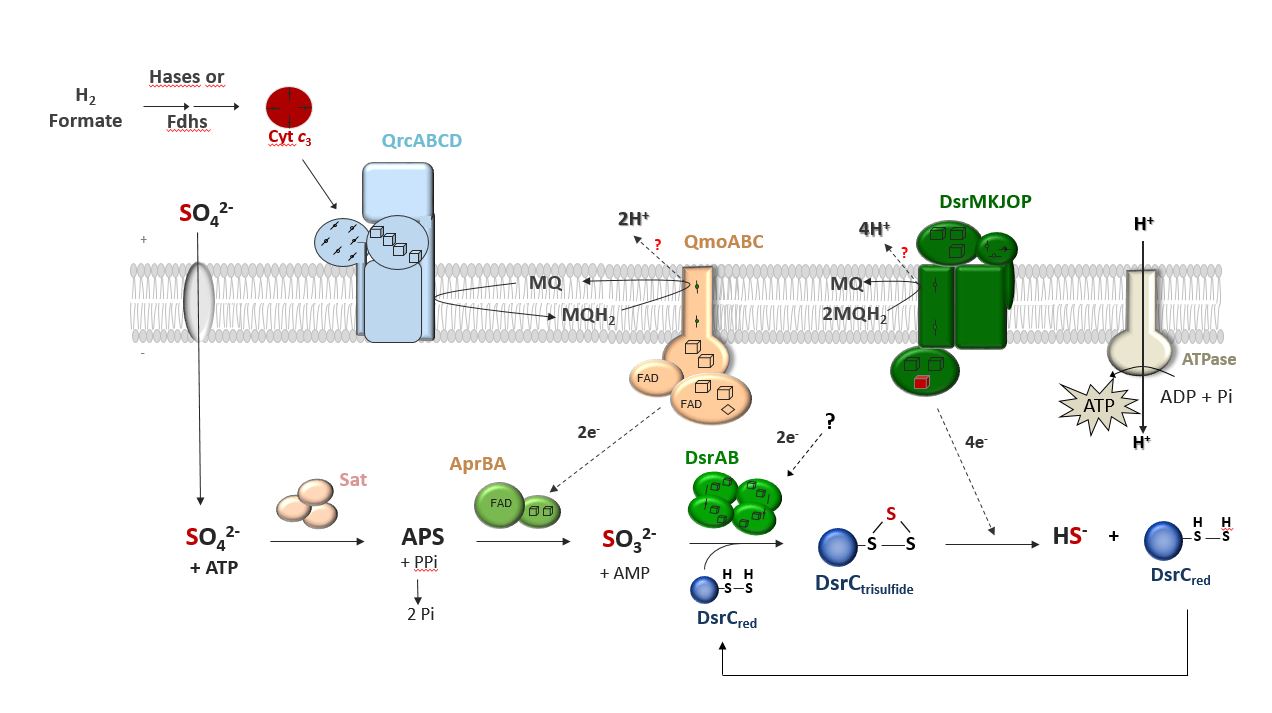
Sulfate respiration is one of the major modes of anaerobic respiration in anoxic environments. This ancient microbial metabolism plays a critical role in the biogeochemical sulfur cycle, and is also important in the gut. Sulfate respiration displays some unique metabolic features, and how microorganisms obtain energy from this process has not been fully established. We investigate the respiratory metabolism of sulfate reducers, which will give us important clues into the evolution of Life on the early earth, and is crucial for exploiting these organisms in biotech applications or for controlling the damaging side-effects of their activity (for example in biocorrosion or in microbiota-associated diseases like colorectal cancer and inflammatory bowel diseases). We focus on the metabolic pathways involved in sulfate/sulfite respiration, and have characterized several essential membrane complexes for the first time, which was an important breakthrough into understanding the mechanism of this process. We also discovered the presence of an additional step in dissimilatory sulfate reduction, involving a protein trisulfide as the product of sulfite reduction. Ongoing studies focus on how the membrane complexes interact with other proteins in metabolic pathways to achieve energy conservation.
Selected publications:
Barbosa ACC, Venceslau SS, Pereira IAC (2024) DsrMKJOP is the terminal reductase complex in anaerobic sulfate respiration. Proc. Nat. Acad. Sci., 121 (6) e2313650121. DOI: 10.1073/pnas.2313650121
Santos A¥, Venceslau SS¥, Grein F, Leavitt WD, Dahl C, Johnston DT and Pereira IAC* (2015) A protein trisulfide couples dissimilatory sulfate reduction to energy conservation. Science 350, 1541
Duarte AG, Catarino T, White GF, Lousa L, Neukirchen S, Soares CM, Sousa FL, Clarke TA & Pereira IAC* (2018) An electrogenic redox loop in sulfate reduction reveals a likely widespread mechanism of energy conservation. Nature Comm., 9, 5448
Nikolay A. Chernyh*, Sinje Neukirchen, Evgenii N. Frolov, Filipa L. Sousa*, Margarita L. Miroshnichenko, Alexander Y. Merkel, Nikolay V. Pimenov, Dimitry Y. Sorokin, Sergio Ciordia, María Carmen Mena, Manuel Ferrer, Peter N. Golyshin, Alexander V. Lebedinsky, Inês A. Cardoso Pereira* & Elizaveta A. Bonch-Osmolovskaya (2020) Dissimilatory sulfate reduction in the archaeon ‘Candidatus Vulcanisaeta moutnovskia’ sheds light on the evolution of sulfur metabolism. Nature Microbiology, 5, 1428–1438 | https://doi.org/10.1038/s41564-020-0776-z
Ferreira D, Barbosa ACC, Oliveira GP, Catarino T, Venceslau SS, Pereira IAC (2022). The DsrD functional marker protein is an allosteric activator of the DsrAB dissimilatory sulfite reductase. Proc. Nat. Acad. Sci., 119 (4) e2118880119; DOI: 10.1073/pnas.2118880119
Neukirchen S, Pereira IAC, Sousa FL (2023) Stepwise pathway for early evolutionary assembly of dissimilatory sulfite and sulfate reduction. ISME J., 17, 1680–1692
DOI: 10.1038/s41396-023-01477-y